Cebu vs wider Asia: what foreign property investors should compare
CebuPropertyMan editorial analysis · Research checked October 11, 2026
For a foreign investor comparing Cebu with Tokyo, Hong Kong, Mumbai or Dubai, the question is whether Cebu offers an eligible, manageable asset with competitive income after costs. Higher rent in a major financial centre is not enough; neither is a lower purchase price in Cebu.
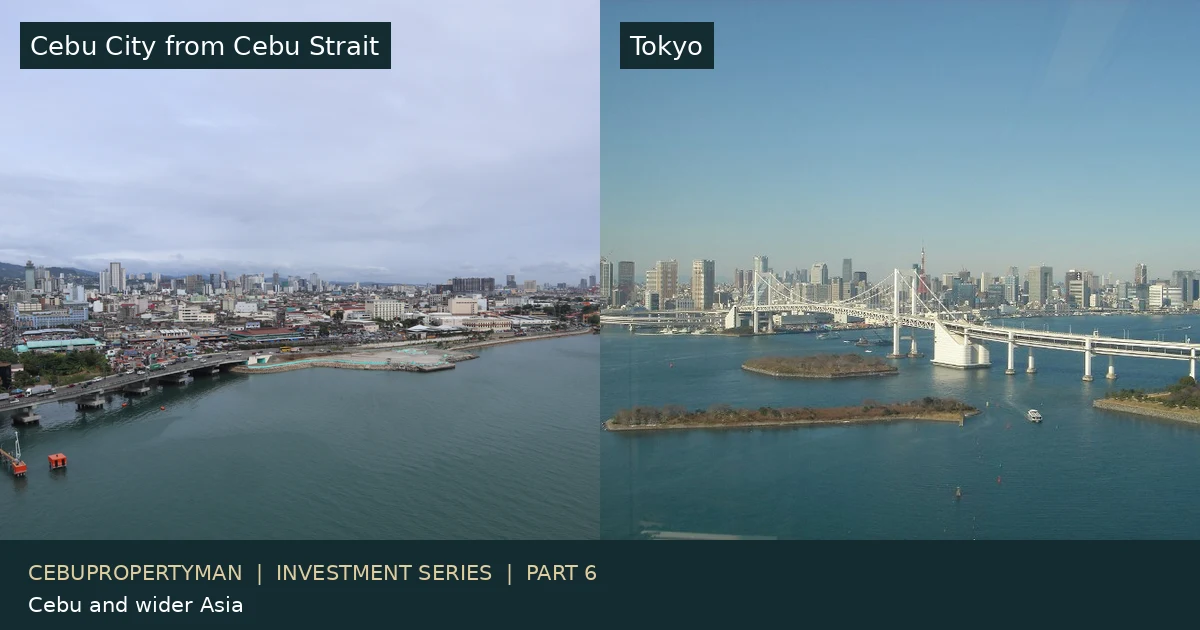
Photo credits

_(1299696620).jpg)
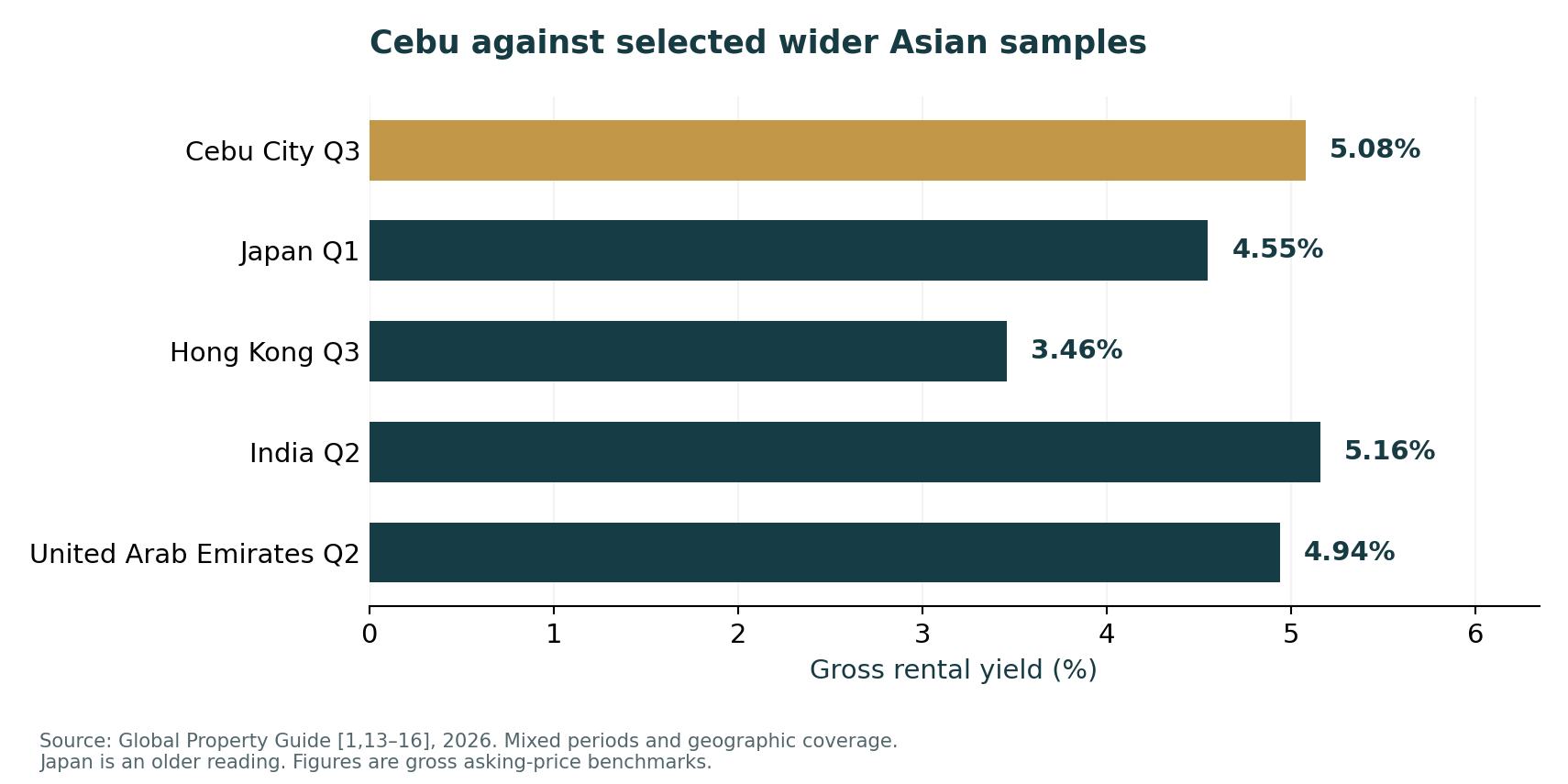
The tables provide context from selected residential markets. They are not a recommendation to buy each example, a uniform Asia-wide average, or proof that the same foreign buyer can acquire every property. Compare nationality, residence, tenure, financing and taxes before comparing percentages.
On mobile, swipe the table to see all columns.
| Published residential sample | Gross yield | Period |
|---|---|---|
| Japan | 4.55% | Q1 2026 |
| Hong Kong | 3.46% | Q3 2026 |
| India | 5.16% | Q2 2026 |
| United Arab Emirates | 4.94% | Q2 2026 |
Source-defined country/territory apartment samples [13–16]. Japan’s displayed page was last updated February 2026 and still indicated a scheduled August update when reviewed; treat it as an older benchmark, not an October reading.
Capital examples across price positions
On mobile, swipe the table to see all columns.
| Residential proxy | Asking price USD | Monthly rent USD | Gross yield |
|---|---|---|---|
| Tokyo lower ticket Eastern 23 Wards studio | 141,000 | 540 | 4.60% |
| Tokyo middle ticket Central 1BR | 572,800 | 1,340 | 2.81% |
| Tokyo higher ticket Central 3BR | 1,330,400 | 2,860 | 2.58% |
| Hong Kong lower ticket Tuen Mun 1BR | 484,600 | 1,645 | 4.07% |
| Hong Kong middle ticket Sha Tin 2BR | 701,600 | 1,860 | 3.18% |
| Hong Kong higher ticket Kowloon Station 3BR | 4,165,000 | 6,100 | 1.76% |
| Mumbai lower ticket Navi Mumbai studio | 34,800 | 140 | 4.83% |
| Mumbai middle ticket Central 2BR | 212,000 | 740 | 4.19% |
| Mumbai higher ticket South 4BR plus | 1,805,500 | 5,470 | 3.64% |
| Dubai lower ticket Downtown studio | 394,800 | 2,040 | 6.20% |
| Dubai middle ticket Downtown 2BR | 1,198,100 | 5,220 | 5.23% |
| Dubai higher ticket Downtown 3BR | 2,341,700 | 7,260 | 3.72% |
Selected asking-price examples only. The relative capital labels are not certified low/mid/high quality classifications. Transaction taxes, tenure, structural condition and furnishings are additional considerations. [13–16]
Commercial growth is not uniform
CBRE’s July 2026 mid-year review projects full-year Tokyo office rental growth of 20%, while noting differing capital-yield directions by location and sector. Singapore yields faced compression; Tokyo office yields could soften, unlike some retail and logistics assets. These are forecasts and market interpretations, not realized returns. [17]
For lower-tier commercial stock, investigate obsolescence and conversion expense. For mid-market premises, test whether a lower occupancy cost attracts durable tenants. For prime assets, assess whether rental growth compensates for the acquisition premium. A lower yield can be rational when income durability and financing are superior, but that proposition must be demonstrated in the specific deal.
Match ownership rights before matching yields
In Cebu, a foreign buyer must verify condominium eligibility and quota; ordinary direct land purchase is generally unavailable. The detailed Philippine ownership and lease framework is explained in Part 5. Foreign ownership of a condo is not the same as eligibility to buy a resort’s underlying land. Sources 23–25.
On mobile, swipe the table to see all columns.
| Market | Foreign-investor diligence | What makes the comparison meaningful |
|---|---|---|
| Cebu | Condominium title, ownership structure, quota and permitted rental use | Eligible unit with verified rent and operating budget |
| Tokyo / Japan | Current nationality/reporting rules, title, building condition and rental permissions | Include refurbishment and management; do not assume unrestricted short stays |
| Hong Kong | Title/lease terms, building charges, current buyer taxes and lender eligibility | Compare full capital and effective rent |
| Mumbai / India | Nationality/residency and applicable foreign-exchange eligibility | An asking-price sample is not permission to purchase |
| Dubai | Foreign ownership permitted in designated freehold areas; verify the particular parcel | Match freehold/leasehold rights and full service charges |
The UAE government identifies designated Dubai freehold areas as available for foreign ownership, including non-residents. That does not make every UAE property or every location eligible. For Japan, Hong Kong and India, this article does not assert blanket access; obtain current jurisdiction-specific confirmation for your status. Source 30.
A Cebu capital anchor in your comparison
On mobile, swipe the table to see all columns.
| Illustrative Cebu residential budget | PHP all-in capital | Approximate USD capital | Rent needed for 6% scheduled gross |
|---|---|---|---|
| Lower-budget scenario | ₱3,000,000 | $47,797 | ₱15,000 / month |
| Mid-budget scenario | ₱6,000,000 | $95,593 | ₱30,000 / month |
| Higher-budget scenario | ₱12,000,000 | $191,186 | ₱60,000 / month |
USD equivalents use BSP’s published ₱62.766 per US$1 reference for 9 October 2026, rounded to whole dollars. This is not a bank conversion quote; spreads and transfer charges are additional. These are hypothetical all-in budgets, not Cebu valuations or verified market tiers. All-in capital includes purchase, closing, furnishing, initial repairs and reserves. Source 26.
Currency can overwhelm a modest yield advantage
Imagine a ₱6M property earning ₱243,000 operating income under the Part 5 assumptions. If the peso weakens 10% against your funding currency and the peso asset value stays unchanged, its translated capital value falls approximately 9.09%. If all income were converted at that year-end rate, translated income plus unchanged peso capital would produce about −5.41% total return in your funding currency, before taxes, transaction costs and financing. This hypothetical is not an exchange-rate forecast; actual timing and hedging change the outcome.
Remote ownership: require control, not reassurance
Ask for monthly statements, rent-roll evidence, a segregated collection arrangement, repair approval limits, inspection reports and a vacancy plan. Identify who handles emergencies and who verifies the manager’s work. In premium residential stock, stress-test a longer vacancy. In mid-market units, check affordability. In lower-budget stock, allow for turnover and maintenance rather than assuming the highest yield means the lowest risk.
Commercial investors need a separate decision
A foreign investor considering a Cebu office condominium, leased commercial premises or a resort operation needs to verify both property rights and any operating-business permissions. Lower-budget premises face tenant concentration and fit-out costs; mid-market premises require a credible occupier; prime assets require evidence that income durability justifies the price. Residential country yields cannot establish commercial returns.
When Cebu deserves the allocation
Cebu can fit a foreign portfolio when the investor deliberately accepts peso exposure and can verify legal ownership, tenant demand and management. A lower-yield destination may be preferable if it offers better control, financing or exit liquidity. The correct conclusion is conditional: buy a supported cash-flow stream and enforceable rights, not a favourable city narrative.
Research sources
- Global Property Guide — Philippines rental yields October 2026 Q3 2026 ↗
- Global Property Guide — Japan rental yields Q1 2026 ↗
- Global Property Guide — Hong Kong rental yields Q3 2026 ↗
- Global Property Guide — India rental yields Q2 2026 ↗
- Global Property Guide — United Arab Emirates rental yields Q2 2026 ↗
- CBRE — Asia Pacific outlook mid year review July and August 2026 ↗
- Philippine Constitution — Article XII: land ownership eligibility ↗
- Philippine Condominium Act — Republic Act 4726, Section 5 ↗
- Philippine Investors’ Lease Act amendment — Republic Act 12252: qualified-investor conditions ↗
- Bangko Sentral ng Pilipinas — PHP/USD reference, 9 October 2026 ↗
- UAE Government — Foreign ownership in designated Dubai areas ↗