When a Cebu property is worth buying and when to walk away
CebuPropertyMan editorial analysis · Research checked October 11, 2026
The city can pass your first screening while the property fails your final test. This closing article turns the comparisons into a buying decision: identify the tenant, price the income and test the downside before committing capital.

Photo credits

The research supports a selective approach. Lower-priced, mid-market and high-end properties can each work, but none is automatically superior. The acquisition price must be consistent with conservative collected rent and the investor’s required net return.
Commercial capital models applicable to any market
On mobile, swipe the table to see all columns.
| Illustrative ticket | Purchase / setup PHP | Monthly base rent assumption | Gross / net yield |
|---|---|---|---|
| Small basic premises | 5M / 0.75M | 35,000 | 8.40% / 5.26% |
| Mid-market premises | 20M / 3M | 130,000 | 7.80% / 4.89% |
| Premium larger asset | 100M / 15M | 550,000 | 6.60% / 4.13% |
Hypothetical models, not local asking prices or commercial market yields. Net assumes 90% collected rent and owner operating expenses of 20% of collections. Denominator includes purchase and setup. Add liquidity reserves and future capital expenditure; financing and income tax are excluded. The same equations apply abroad using local currency, taxes and lease conventions.
Price the income before choosing the address
At PHP600,000 verified annual stabilized NOI, a 4%, 6% or 8% acquisition cap rate implies PHP15M, PHP10M or PHP7.5M respectively, before transaction costs. These rates are valuation sensitivities, not observed market cap rates. A broker’s gross yield must not replace verified NOI in this calculation.
On mobile, swipe the table to see all columns.
| Tier | Residential discipline | Commercial discipline |
|---|---|---|
| Lower-priced | Check affordability, collections, lawful occupancy and repair intensity | Check tenant credit, frequent turnover and legal permitted use |
| Mid-market | Avoid buying a standard product at a premium unsupported by rent | Underwrite vacancy, tenant improvements and re-letting costs |
| High-end | Require proof of rent premium and budget for long vacancies | Require durable leases and assess expensive systems and capex |
Stress test before borrowing
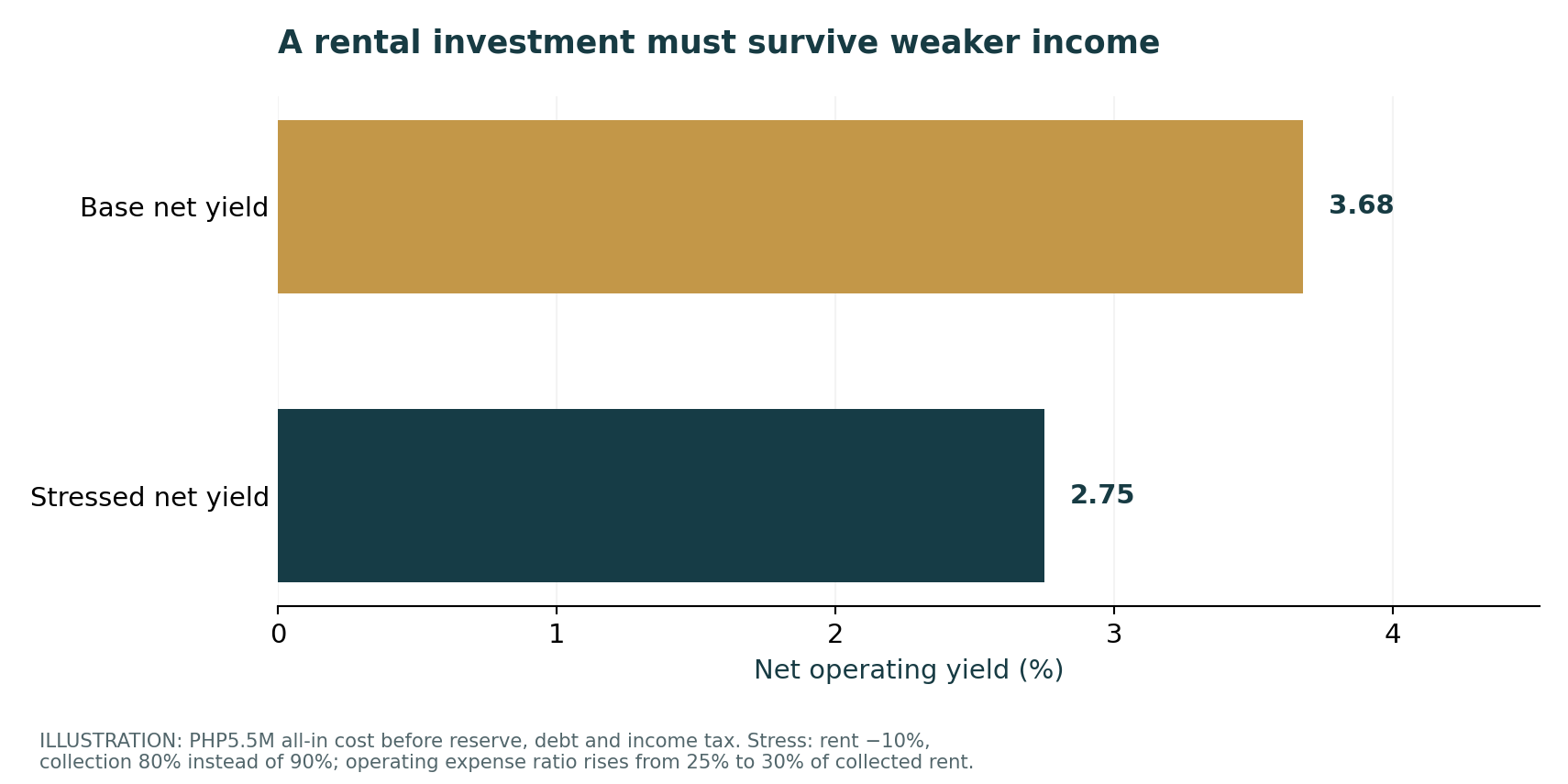
Test rent down 10%, collection down from 90% to 80%, the operating expense ratio rising from 25% to 30% of collections, and a realistic repair event. In the PHP5M residential example from Article 1, those combined rent, collection and expense stresses reduce annual NOI to PHP151,200, or 2.75% on PHP5.5M. A separate six-month vacancy scenario needs cash reserves, not an assumption of rapid re-letting.
For a purely illustrative PHP4M loan at 7% over 20 years, amortizing debt service is about PHP31,012 monthly. That exceeds the PHP25,000 scheduled rent before expenses. Leverage increases exposure; it does not repair weak property economics. This is a calculation assumption, not a current bank quotation.
Evidence required before an investment recommendation
Obtain comparable signed leases, a rent roll and collection records where available; current dues, insurance, tax and repair budgets; title, tenure and authority checks; lease terms and tenant deposits; and an independent view of resale liquidity. For commercial property, include rent-free periods, fit-out contributions, recovery clauses, upcoming lease expiries and replacement capital expenditure.
The series supports using Cebu as the starting market for disciplined deal screening. It does not support a claim that Cebu always beats Visayas, Asia or global alternatives. Prefer verifiable cash flow and a margin of safety over an attractive brochure yield.
Research sources
- Global Property Guide — Philippines rental yields October 2026 Q3 2026 ↗
- Cushman and Wakefield — Investment MarketBeat Q2 2026 August 17 2026 ↗
- CBRE — Asia Pacific outlook mid year review July and August 2026 ↗
- JLL — Global Real Estate Perspective August 2026 ↗