Can the property produce a viable rental return
CebuPropertyMan · Published 11 October 2026

Start with the tenant, not the yield advertised beside the listing. Who would rent this asset, why would they choose it, and what would they pay under current conditions? A discounted purchase in a weak rental location can still be a poor income investment.
Build evidence for the rent assumption
Compare similar properties within the actual catchment area. Match size, condition, parking, access and furnishing. Distinguish asking rents from signed leases and achieved rents. Record how long comparable units have been marketed and whether incentives explain a headline rate. In Cebu, test commute practicality and local competition instead of assuming every property near a business district benefits equally.
For residential rentals, budget for turnover, repairs, collection losses, association charges, insurance and management even if you initially manage the property yourself. For a condominium, verify permitted lease arrangements with building administration.
For commercial assets, inspect the lease economics carefully: allowable business use, lease duration, tenant financial capacity, fit-out responsibilities, rent-free periods, reinstatement obligations and the time needed to replace a tenant. Separate base rent from recoverable service charges and VAT where applicable. A long lease with an unreliable tenant is not necessarily secure income.
Gross yield leaves out the work
Use the same PHP 3.85 million illustrative invested-cost basis from Part 4. Assume monthly rent of PHP 24,000, one vacant month and annual owner operating expenses of PHP 70,000. These figures are invented for calculation practice and are not Cebu rental-market estimates.
| Measure | Calculation | Result |
|---|---|---|
| Scheduled annual rent | 24,000 × 12 | PHP 288,000 |
| Rent after one vacant month | 24,000 × 11 | PHP 264,000 |
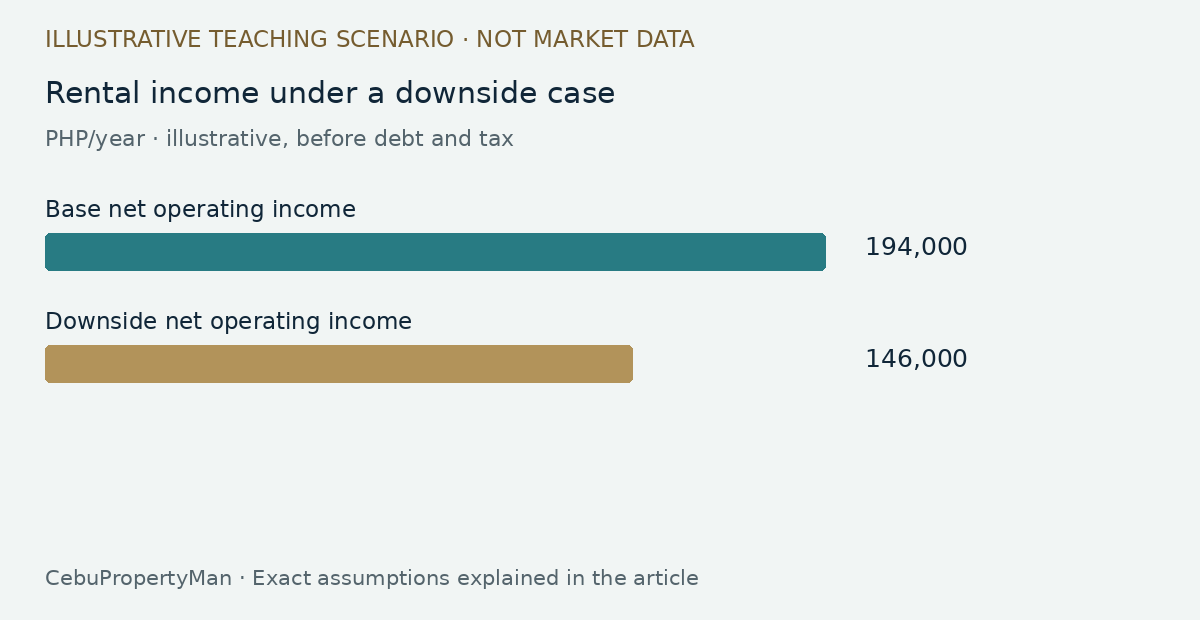
| Net operating income | 264,000 − 70,000 | PHP 194,000 |
| Gross yield on invested cost | 288,000 ÷ 3,850,000 | 7.48% |
| Net operating yield on invested cost | 194,000 ÷ 3,850,000 | 5.04% |
The net operating yield above is before financing and income tax. It is calculated on invested cost, not market value, and is not a cap rate measured against an independently assessed current value. Principal repayment belongs in the debt cash-flow calculation, not operating expenses.
Run a downside case with two vacant months and rent 10% lower. Rent collected becomes PHP 216,000; holding the illustrative operating expenses at PHP 70,000 leaves PHP 146,000 of operating income, or 3.79% on cost. Actual expenses may also change.
Accept a rental purchase only when the evidence and downside cash flow fit your target return, liquidity and workload. Appreciation should remain a possible upside, not the rent shortfall’s only explanation.
Original educational analysis with hypothetical calculations. Verify the costs and market evidence for your property.