INHERITED PROPERTY · ESTATE SETTLEMENT ROUTES
Extrajudicial Settlement vs Judicial Settlement of Estate in the Philippines

← Back to the main guide: Selling inherited property
Choose the process from the estate facts
Inheritance rights, settlement and a title ready for transfer are different. Identify entitlement, settle obligations/distribution, establish sale authority and complete tax/registration work. Before partition, several heirs generally co-own the estate subject to debts; one heir cannot therefore sell everything alone. Civil Code
Identify heirs and property interests first. A signed agreement or the simplest document name does not establish the correct route.
The routes at a glance
- EJS: qualifying heirs divide without letters of administration; Rule 74 conditions and participation still apply.
- Self-adjudication: a qualifying sole heir uses an affidavit; the affidavit does not create sole-heir status.
- Probate/administration: allowance of a will and administration address different questions; neither alone completes every transfer.
- Partition: division of co-ownership where legally appropriate; not automatically full administration.
- Judicial summary settlement: the separate conditional Rule 74 section 2 court procedure, not an out-of-court shortcut.
These are discussion categories, not a route calculator or ranking by speed/cost. Pending proceedings, debts, minors and foreign elements require review. Rules of Court
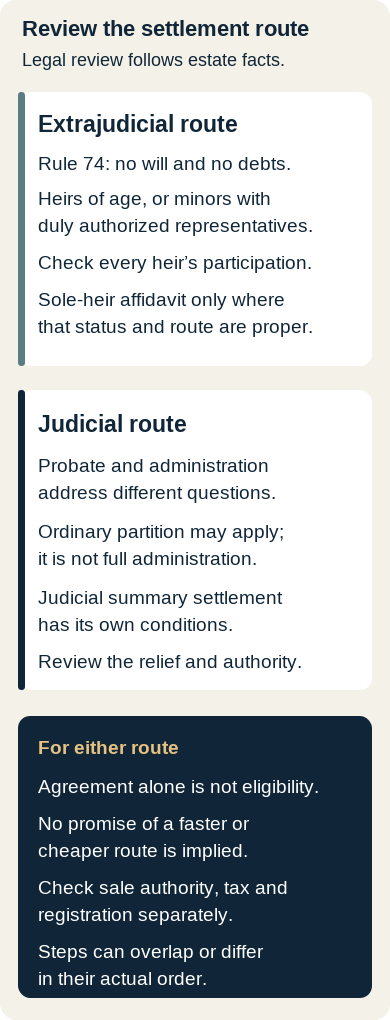
When may Rule 74 EJS be considered?
Section 1 requires no will and no debts, with all heirs of age or minors represented by judicial or legal representatives duly authorized for the purpose. It permits division without letters of administration through a public instrument filed with the Register of Deeds. Agreement alone is insufficient. Rules of Court
The rule presumes no debts if no creditor petitions for letters within two years after death. This is not an instruction to wait two years, conceal obligations or replace “no debts” with “no known debts.” Confirm the actual obligations with counsel.
A sole heir may use the affidavit route subject to its conditions and formalities. Verify records, succession law and other potential heirs; possession, expenses or holding the title does not prove sole heirship. All-heir participation is not majority voting. Overseas, unavailable or represented parties need proper authority. A minor’s inheritance does not authorize any adult to dispose of it; particular court/disposition requirements are outside this guide.
Publication does not cure missing participation
Notarization and publication do not establish disputed heirship, authentic signatures or representative authority. PD 1529 section 86 addresses the instrument, publication once weekly for three consecutive weeks in the specified newspaper, proof and annotation. PD 1529
Publication is a required safeguard, but it does not automatically cure every omission or notice defect. Rule 74 limits binding effect on those who did not participate or had no notice. Decisions caution that publication after execution does not necessarily bind uninvolved heirs, nor does registration prove sole heirship or create a blanket two-year defence. Rules of Court · Supreme Court decision · Claims decision
Counsel must assess the deed, dates, notice, entitlement, remedy and forum. Neither “every omission voids everything” nor “publication ends all rights” is safe. Oral partition can bind heirs in appropriate proved circumstances, but that is not advice to convey registered land on an undocumented understanding. Binding effect, proof and registration requirements are separate. Supreme Court decision
For the title annotation and different forms of security, see the Rule 74 and heirs’ bonds guide. Keep settlement eligibility separate from a buyer’s or lender’s conditions.
Court route and sale route remain different questions
A will generally needs allowance before passing property, but not every will entails identical administration. Debts, disputed interests or disagreement can require different proceedings; ordinary partition may be appropriate in a qualifying estate. Review probate, administration, partition and court questions.
Separate the estate interest from a spouse’s or co-owner’s own interest. For administration, inspect the letters, will, orders and proposed act. Rule 89 and PD 1529 address dispositions; PD 1529 recognizes an executor’s will-based power in its specified setting, so the same separate order is not universal. An SPA or marketing authority cannot create ownership or replace required approval. Family Code · PD 1529
Settlement eligibility does not itself choose transfer-first or a combined settlement-and-sale structure. Review parties, obligations and registration sequence; do not promise efficiency or tax savings without verification. In a transaction I was closely involved in, settlement questions overlapped buyer discussions; no final structure is asserted.
Compare estate-to-heirs-to-buyer and legally appropriate combined settlement-and-sale structures with counsel and the offices. LRA’s form is a reference, not automatic acceptance. A combined document does not mean one tax event. Check authority, chain of title, lender acceptance, registration sequence and obligations; do not promise savings or speed. Market asking-price evidence is not statutory estate-tax valuation. LRA forms · Market Insights
Before committing to a transfer
Keep the personal-property bond, real-property lien and any private security request distinct. PD 1529 requires annotation; Rule 74 section 4 addresses real-property exposure for two years after distribution notwithstanding transfers. Sale is not the universal starting date or universally barred; annotation cancellation requires the verified-petition procedure and stated conditions, and participation/notice can affect claims. Rules of Court · PD 1529 · Supreme Court decision
An EJS is not an eCAR; a court order does not prove completed tax or registration work. Use the readiness record to track wills, heirs, successive deaths, spouses’ interests, minors, debts, pending cases, agreed property, sale authority and outstanding requirements. Unanswered questions select no route automatically; this is not an heirship certification or legal opinion.
CebuPropertyMan can help organize property and brokerage questions. Estate advice and signing authority require counsel. Start a conversation.
Keep settlement authority separate from tax clearance. The estate-tax, BIR requirements and eCAR guide explains the records to confirm before promising a transfer date.
References & Legal Sources
11. Downloadable forms — Land Registration Authority. Official index includes EJS of estate with absolute sale; reference does not replace case-specific review. View the forms.
1. Rules of Court, Special Proceedings, Rules 73–90. Primary text. Relevant pinpoints: Rule 73 §1; Rule 74 §§1–5; Rules 75–79; Rule 83 §1; Rule 86; Rule 89; Rule 90 §1. Historical court names and amounts are not copied as present filing instructions.
2. Civil Code, RA 386. Primary text, Articles 777, 1078, 1082 and 1091. Succession and partition principles do not establish any particular person's shares here.
3. Property Registration Decree, PD 1529. Primary text, §§86–90. Includes the annotation procedure and the will-power exception; not a complete transfer checklist.
4. Heirs of Arturo E. Bandoy v. Alexander E. Bandoy, GR 255258, 19 October 2022. Decision. Relevant to settlement/partition distinctions and proof of an asserted oral partition.
7. Family Code, EO 209. Primary text, Articles 103 and 130. Application depends on the relevant property regime and facts.
8. Beltran v. Ayson, GR L-14662, 30 January 1962. Decision. Cited narrowly on Rule 74 participation/notice and the two-year limitation, not for historical inheritance shares.
9. Cua v. Vargas, GR 156536, 31 October 2006. Decision. Complete decision reviewed; cited narrowly on publication after execution and heirs who lacked knowledge or participation. The separate redemption issues are outside this guide’s scope.