INHERITED PROPERTY · SPECIAL HEIR QUESTIONS
Inherited Property: Grandchildren, Adoption and Other Heir Questions

← Back to the main guide: Who inherits?
Children, prior relationships and filiation
Include potentially relevant children from every relationship. A different surname, limited contact, residence abroad or a separate household does not resolve entitlement. Legitimate/illegitimate remain legal classifications; marital/nonmarital are used descriptively, without a judgment about worth. Establish status under current law, including exceptions—not family labels. Family Code
Article 176 as amended by RA 9255 relates an illegitimate child’s legitime to a legitimate child’s. It does not give half the whole estate or resolve every competing entitlement. Read it with succession limits and the actual heir configuration. Proof and time limits for filiation are separate from surname use and depend on documents/history. Disputed status needs counsel, not a broker’s decision. RA 9255 · Civil Code · Supreme Court decision
Legitimation is distinct. A later marriage does not automatically legitimate every child. Article 177 as amended by RA 9858 sets conditions; Articles 178–179 address subsequent valid marriage and rights. Verify effective status rather than freezing a child in the wrong category. RA 9858 · Family Code
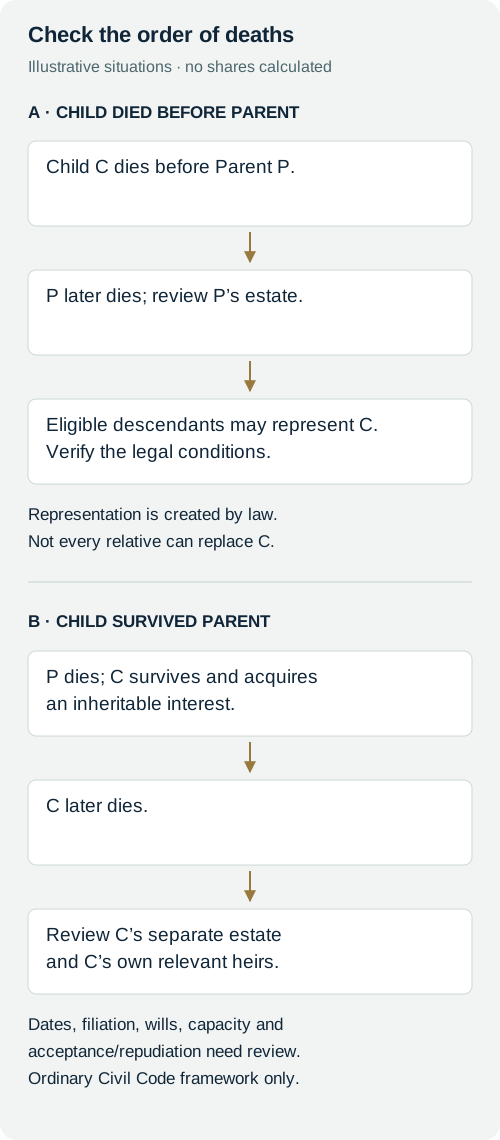
Predeceased heir or later estate?
Assume ordinary Civil Code succession applies. If Child C died before Parent P, C’s descendants may represent C only where the law permits and filiation/capacity are established. Representation ordinarily works by branch, not equal shares for every grandchild and surviving child. It is not appointment by relatives, does not operate in the ascending line and is restricted among collaterals. Repudiation does not automatically make an heir “predeceased” for representation. Civil Code
If C survived P, inherited an interest and later died, that interest belongs in C’s own estate; C’s relevant heirs may differ. C’s spouse may have rights through C’s estate without being P’s compulsory heir as an in-law. A decision illustrating these different death sequences also involved disputed marriage and proper proceedings; those questions still need proof. Supreme Court decision
These are hypotheticals, not the author’s family. Verify dates, wills, filiation, capacity, acceptance/repudiation and applicable law. Do not invent an uncertain death sequence; the Civil Code has a proof rule. Each estate may need separate succession and tax review under its relevant date-of-death regime. Civil Code · BIR guidance
Nonmarital grandchildren: the decision has limits
A Supreme Court decision held that Article 992 does not bar a nonmarital child from representing a parent in the direct line for the parent’s share in a grandparent’s legitime, subject to representation requirements and proof of filiation. It did not decide every Article 992 situation, inheritance in one’s own right or collateral succession; factual filiation still required determination. It does not mean every grandchild inherits or that Article 992 was abolished. Supreme Court decision
Record the potential branch for counsel. Do not erase it using an outdated blanket exclusion or promise a share from the decision alone.
Adoption: verify the legal status
Under RA 11642 the adoptee is treated as the adopter’s legitimate child; Section 41 addresses extended adoptive filiation, and Section 43 reciprocal adopter/adoptee succession without distinction from legitimate filiation. The Act also addresses severance of biological-parent ties, the spouse-of-adopter exception and testamentary succession involving biological parents. Adoption law
Informal care, foster care, surname use and legal adoption are different. Check the order, effect and applicable regime. Historical/foreign adoption and wider-relative claims need individual review; no shares among those relatives are allocated here.
Minors and representation
Age does not erase inheritance rights or free adults to divide a child’s interest. Acceptance differs from repudiation, which requires judicial authorization. Rule 74 addresses duly authorized representatives; a minor does not automatically permit or prohibit EJS. Civil Code · Rule 74
This guide does not state the complete court or guardianship procedure for selling, partitioning or disposing of a minor’s interest. Have counsel check representation, conflicts and authority for the actual act; parental administration is not unrestricted disposal power. A 2024 guardianship decision emphasizes best interests and qualifications/conflicts, not a sale-approval shortcut. A conceived child may also matter under Civil Code conditions. Supreme Court decision · Family Code · Civil Code
Nationality and applicable law are separate questions
Civil Code Articles 16 and 1039 refer succession and capacity-to-succeed questions to the decedent’s national law. This differs from asking where the property lies or an heir lives. The heir’s capacity to acquire Philippine land is another question: the hereditary-succession exception is not blanket clearance for every foreign beneficiary or testamentary transaction. Civil Code · Constitution
Confirm citizenship at relevant dates, the property and legal route. Do not mechanically apply the ordinary Civil Code framework where Muslim personal law or another special regime governs. Foreign-law proof, changing nationality and conflicts need specialist review. Personal-law scope
Return to the core heir framework with relationship records, death chronology and unresolved questions. No shares are calculated.
References & Legal Sources
6. RR 12-2018, official digest — Department of Finance/BIR. Estate-tax accrual and date-of-death applicability of TRAIN provisions. Read the BIR digest.
3. RA 9255, Sec. 1. Amended Article 176; distinguish surname use, proof of filiation and legitime. Read the Act.
4. RA 9858, Sec. 1. Conditions for legitimation and subsequent valid marriage. Read the Act.
5. RA 11642, Secs. 41–43. Legitimacy and extended adoptive filiation, parental ties and succession. Do not substitute repealed RA 8552 as the current general adoption statute. Read the Act.
7. Aquino v. Aquino, G.R. Nos. 208912 and 209018, 7 December 2021, En Banc. Majority decision's Article 992/982 discussion and express limitation to representation, followed by remand for filiation findings. Separate opinions are not substituted for the majority holding. Full decision.
1. Civil Code, RA 386. Arts. 16, 40â43, 777â781, 842, 854, 886â909, 915â923, 960â1001, 1039, 1042â1051 and 1078: applicable law, timing, legitime, classes, representation, repudiation and co-ownership. Older child classifications must be read with the Family Code and later laws. Primary statutory text.
11. 1987 Constitution, Art. XII, Secs. 7–8. Philippine landholding and hereditary-succession exception; foreign citizenship requires case-specific analysis. Primary constitutional text.
2. Family Code, EO 209, as amended. Arts. 54, 63, 75, 92, 102–103, 109, 129–130, 147–148, 164–179 and 225: status, property interests, filiation and minors. Article 176 is updated by RA 9255; Articles 177–178 by RA 9858. Primary statutory text.
8. Macalinao v. Macalinao, G.R. No. 250613, 3 April 2024. Majority decision's apportionment discussion and disposition: preservation of legitimes in the specified mixed-child configuration. Death-benefit context expressly retained; no general benefit/estate equivalence or universal share formula inferred. Full decision.
12. Code of Muslim Personal Laws, PD 1083, Arts. 3 and 89–91. Scope warning: ordinary Civil Code representation rules must not be transplanted into a different applicable personal-law regime. Primary statutory text.
6. Rules of Court. Rule 74, Sec. 1; Rule 75, Sec. 1; Rule 95: estate-settlement conditions, probate and authority for dispositions of property under guardianship. Read guardianship rules with the Family Code and the applicable special rules for minors; this article gives no filing checklist or fee/bond threshold. Primary rules text.
13. Santos v. Republic, G.R. No. 268643, 10 June 2024. Guardianship qualifications, child welfare and the current Rule on Guardianship of Minors context; no disposition authority inferred from appointment alone. Full decision.
9. Tirol v. Nolasco, G.R. No. 230103, 27 August 2020. Order of deaths, an heir's interest passing through their own estate, representation, and proper estate proceedings. Full decision.