Selling an Inherited Property in the Philippines: A Step-by-Step Guide

Photo: RDNE Stock project / Pexels, Pexels License. Cropped and resized.
In this guide
- Why we created this guide
- 1. Start with the registered owner and the death record
- 2. Identify all heirs before planning the sale
- 3. Determine whether the property was exclusive, community or conjugal
- 4. Determine the estate-settlement route
- Inherited Property Sale Readiness Roadmap
- 5. Check the estate-tax situation early
- 6. Understand Rule 74 before promising a clean transfer
- 7. Coordinate overseas heirs before marketing aggressively
- 8. Decide how the property will move from estate to buyer
- 9. If several generations have died, stop and map the chronology
- 10. Inherited Property Seller Readiness Checklist
Before discussing a selling price or promising a completion date, establish who has an interest in the property, who can sign, and what remains unresolved. A willing buyer is only one part of the transaction.
This guide maps the main sale-readiness questions for inherited property in the Philippines. The actual route depends on the family, the property, the applicable law and the documents—not simply on how long the title has remained in the deceased owner's name.
Why we created this guide
An inherited-property transaction involving people close to me became one of the most educational property transactions I have been involved in.
We encountered unsettled estate tax, multiple heirs, and the practical difficulty of coordinating heirs living abroad. Special Powers of Attorney and identification documents needed attention. An unresolved BIR registration connected with the decedent’s real estate practice, which had not been properly closed or updated, also surfaced during estate processing and created additional BIR work.
There were estate-settlement complications, Rule 74-related exposure and a financial-protection requirement involving a bond, surety or similar arrangement. Those experiences belong in this account, but their precise legal basis must not be assumed. In particular, we are not presenting the security encountered in our transaction as a universal legal requirement for every inherited-property sale.
The lesson was clear: selling inherited property is rarely just a matter of finding a buyer and signing a deed. This guide uses that experience as context, then separates it from what the authorities actually say.
CebuPropertyMan Research & Experience Note
These guides combine first-hand transaction experience with research from Philippine laws, government issuances, court decisions, and other credible public materials. The goal is to help property owners understand the process, anticipate common issues, and know when professional legal or tax advice may be needed.
This guide is for educational purposes only and is not individualized legal or tax advice. Estate, inheritance, tax, citizenship, marital-property, title, and registration issues can vary significantly depending on the facts.
1. Start with the registered owner and the death record
Begin with the title and supporting records. Confirm whose names appear, whether each registered owner is alive, and the date of death of any deceased owner. Obtain a current certified title copy and the relevant death certificate. If several owners appear on the title, record their circumstances separately.
Legal starting point: Civil Code Articles 774 and 777 recognize succession through death and transmission of succession rights from that moment. That does not mean a death certificate alone is sufficient for an unrestricted sale or registered transfer. Civil Code, Arts. 774 and 777.
Compare the title copy, owner-held duplicate, acquisition records and tax declaration. Note inconsistent names, annotations and missing documents as questions for review. LRA identifies a certified title copy as a due-diligence resource and lists separate documents for registration. LRA registration guidance.
What to prepare: a title file, death record, owner-by-owner chronology and a short list of discrepancies. Finding these questions early is more useful than assuming an old title will be straightforward to transfer.
2. Identify all heirs before planning the sale
Build a family map before collecting signatures. Record the surviving spouse, children—including children from prior relationships—relevant parents or other relatives, deceased heirs, minors, and any will. Do not assume that the people currently occupying the house are the complete group whose interests matter.
Legal starting point: the Civil Code addresses compulsory heirs and legitime, the reserved part of an estate protected for certain heirs. Those rules must be distinguished from the rules governing intestate succession. Representation and the sequence of deaths can also affect the analysis. Civil Code, Arts. 886–887, 960 and 970–972.
The practical task here is to identify people and evidence, not to assign percentages from an incomplete family story. Prepare relationship records, marriage and death records where relevant, and information about the will for a lawyer's assessment. Where foreign elements arise, applicable succession law is another question for counsel. Civil Code, Art. 16.
Planned specialist guide: Who Inherits the Property? Heirs, Legitime, Spouses and Children Explained. This guide is being prepared; no specialist article is linked until it exists.
3. Determine whether the property was exclusive, community or conjugal
The entire property is not necessarily the deceased's estate. A surviving spouse may have an ownership interest arising from the property regime, separately from any inheritance entitlement.
The marriage date, marriage settlements, acquisition date, source of acquisition and applicable law matter. The Family Code distinguishes property regimes, community-property exclusions and exclusive property under a conjugal partnership. It also provides for liquidation upon death. These provisions are not a shortcut to assuming that every surviving spouse simply owns a fixed percentage of every asset. Family Code, Arts. 75, 92, 103, 109 and 130.
What to prepare: the acquisition instrument, marriage information, any marriage settlement and records showing how the asset was acquired. Ask counsel to establish what belongs to the estate before discussing inheritance shares or sale proceeds.
Planned further reading: the heirs and property-interests guide introduced in Section 2.
4. Determine the estate-settlement route
An Extrajudicial Settlement, or EJS, is not automatically appropriate because some relatives agree to sell.
Procedural rule: Rule 74, Section 1 provides an out-of-court route where the decedent left no will and no debts, with adult heirs or minors represented by duly authorized judicial or legal representatives. It provides for a public instrument and, for a sole heir, an affidavit of self-adjudication. These conditions require careful application. Rules of Court, Rule 74, Sec. 1.
A will raises probate questions; Rule 75, Section 1 requires its allowance by the proper court before it passes property. Missing participants, disputes, debts or capacity issues may require a different legal route. Do not conceal an unresolved problem merely to fit an EJS form. Rules of Court, Rule 75, Sec. 1.
For registration, PD 1529, Section 86 requires publication and proof of it. LRA's guidance also identifies additional requirements where minors are involved. A lawyer should assess the legal authority, and the relevant RD should confirm the registration documents for the transaction. PD 1529, Sec. 86; LRA registration guidance.
What to prepare: the will or confirmation that none is known, information about debts, all participants' circumstances, existing settlement documents, publication evidence and any court orders.
Planned specialist guide: Extrajudicial vs Judicial Settlement of Estate in the Philippines.
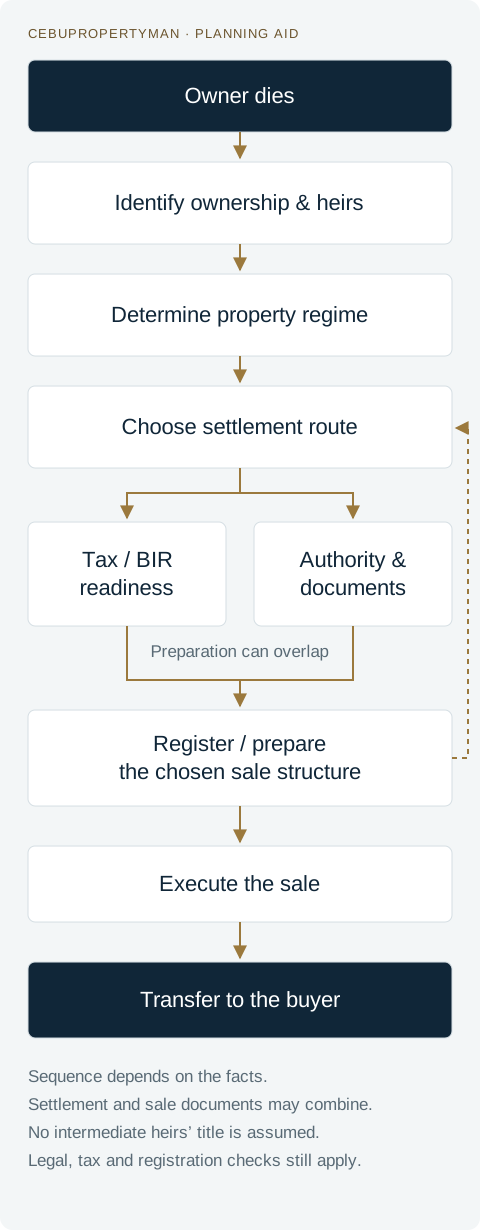
Inherited Property Sale Readiness Roadmap
Ownership, family and property-regime checks inform the settlement route. Tax work and overseas-document coordination can involve overlapping preparation. The chosen route then determines how the settlement, sale documents and registration are coordinated.
The roadmap is a planning aid, not authority to execute a sale. An EJS, a tax payment or a signed SPA alone does not establish that every other requirement has been satisfied. Where an estate is settled with a sale, settlement and sale documentation can be combined; do not read the diagram as requiring an intermediate title in the heirs' names in every case.
5. Check the estate-tax situation early
Ask a tax practitioner to establish the applicable date-of-death regime before estimating tax or promising completion. TRAIN changed estate-tax provisions, and BIR's RR 12-2018 explains the regime for deaths from its applicable effectivity. Do not apply today's headline rate or deductions indiscriminately to an earlier death. RA 10963, Secs. 22–26; BIR RR 12-2018 digest.
Keep five questions separate:
- Estate-tax liability: what return, valuation, deductions and payment treatment apply?
- Penalties and interest: what additions, relief or payment arrangements apply to this estate, if any?
- eCAR processing: what evidence does BIR need to issue its electronic Certificate Authorizing Registration?
- Historical professional registration: is there an unresolved BIR registration connected with the decedent’s real estate practice?
- Related compliance questions: do records identify a filing, cessation, registration-update, open-case or clearance issue tied to that practice? Do not assume which applies.
BIR RMC 75-2026 distinguishes tax filing/payment from the eCAR application: processing remains with the BIR office having jurisdiction over the transaction. It also addresses complete documentary submissions and the point at which the published processing period starts. Time spent gathering family records is not the same as that processing period. Confirm the current estate requirements and responsible office before promising a completion date. BIR RMC 75-2026, Q4, Q6–Q8 and Q13.
RMO 17-2026 updates ONETT procedures and forms, including distinctions between estate processing and sale/donation workflows. It also addresses settlement-with-sale records; a combined document does not remove estate-specific requirements. Its sale/donation procedures should not be treated as a universal estate-settlement checklist. BIR RMO 17-2026, Parts III and V.
Treat estate-tax amnesty as a dated eligibility question
RA 11956 set a historical amnesty-availment window. BIR's 2026 clarification distinguishes that window from later submission of settlement proof for eCAR. Continuing documentary work for a qualifying application does not itself reopen amnesty to a new applicant. Verify the actual return, payment history and applicable issuances rather than assume relief remains available. RA 11956; BIR RMC 33-2026, Q1.
What we encountered
In our transaction, an unresolved BIR registration connected with the decedent’s real estate practice had to be addressed during estate processing. This created additional BIR work. We have not verified the precise historical compliance issue and do not infer a particular filing, cessation, registration-update, open-case or clearance requirement. This is separate from estate-tax obligations and estate-transfer eCAR processing; it is not a universal estate requirement.
Current BIR guidance also says that closure of the decedent’s business registration need not precede filing of the estate-tax return, and that closure processing may proceed in parallel with estate-tax processing. This does not establish the precise historical issue in our transaction. BIR RMC 75-2026, Q44–Q45.
What to prepare: prior estate returns and payment evidence, any eCAR or application records, relevant BIR correspondence, and a written list of unresolved issues for the tax practitioner/RDO.
Planned specialist guide: Estate Tax and BIR Requirements Before Selling an Inherited Property.
6. Understand Rule 74 before promising a clean transfer
Three different matters need separate explanations:
- The statutory personal-property bond. Rule 74, Section 1 relates the bond to the value of personal property involved in the settlement. Section 3 addresses a bond in the applicable summary-settlement procedure. Neither is a blanket instruction to insure every inherited house for its full value. Rules of Court, Rule 74, Secs. 1 and 3.
- Exposure affecting real property. PD 1529, Section 86 provides for annotation of the Rule 74 two-year lien after registration of an EJS. The statute also addresses cancellation by verified petition under its conditions. Merely marking two years on a calendar is not the complete due-diligence exercise. PD 1529, Sec. 86.
- Additional transaction security. If someone requests a bond, surety, reserve or other protection, ask who requires it, what risk it addresses, and what document sets its amount, duration and release conditions. Its basis may be contractual or transaction-specific; do not label it a statutory requirement without verification.
Creditors and omitted heirs require careful review. In Beltran v. Ayson, the Supreme Court explained limitations on applying Rule 74's two-year bar to people who had not participated or had no notice. Do not assume that every claim disappears two years after a sale; the relevant dates and facts matter. Supreme Court, G.R. L-14662, 30 January 1962.
What happened in our transaction vs what Rule 74 actually requires
In this transaction, we encountered a financial-protection requirement. The precise requester, instrument and legal basis have not been verified for this article. We therefore describe it as something encountered in our transaction, separately from the statutory personal-property bond and the real-property annotation.
What to prepare: the annotated title, settlement and publication records, any claim information and the written terms of any requested security. Have counsel and the requester explain the basis before making commitments.
Planned specialist guide: Rule 74, Heirs’ Bonds and the Two-Year Claim Period Explained.
7. Coordinate overseas heirs before marketing aggressively
Confirm who will sign personally, who needs a representative, and what the representative must do. Civil Code Articles 1874 and 1878 require written/special authority for relevant real-property acts. Have the authority drafted for the actual transaction rather than assume a general authorization covers everything. Civil Code, Arts. 1874 and 1878.
For documents executed abroad, determine the applicable notarization, apostille or consular route with the relevant authorities. DFA guidance distinguishes foreign documents apostilled by the competent foreign authority for use in the Philippines. This does not establish that every document from every country follows one route. DFA Apostille guidance.
Keep three checks distinct:
- Identity: does the document reliably identify the signing heir, including any name differences?
- Citizenship history: what evidence of current or former citizenship is relevant?
- Substantive eligibility: can the person acquire, hold or dispose of the interest under the applicable law? Article XII, Sections 7–8 of the Constitution provides the land/citizenship framework, including hereditary-succession and former-natural-born-citizen provisions; a passport checklist cannot answer every eligibility question. 1987 Constitution, Art. XII, Secs. 7–8.
Before signing abroad, have the proposed documents checked for the intended BIR, RD and lender process. Plan delivery of originals where required and allow for corrections without promising a fixed turnaround. The transaction I was closely involved in showed how overseas coordination can create practical document work; it did not establish a universal country-by-country requirement.
Planned specialist guide: SPA, Heirs Abroad and Documents for Selling Inherited Property.
8. Decide how the property will move from estate to buyer
Discuss two possible structures with counsel and the processing offices:
| Structure | What to examine before choosing it |
|---|---|
| Route A: estate → heirs → buyer | Settlement/registration into the heirs' names, followed by sale; confirm authority, documents, separate tax work and buyer/lender requirements. |
| Route B: settlement/EJS with sale → buyer | Whether a combined settlement-and-sale instrument and the proposed registration sequence are legally appropriate and acceptable for the actual case. |
LRA publishes an Extrajudicial Settlement of Estate with Absolute Sale form. That confirms an official reference for this instrument, not automatic acceptance of every proposed direct-to-buyer transfer. LRA downloadable forms.
Compare the chain of title, participants' authority, documentation, buyer/lender comfort, estate-related and sale-related tax events, registration steps and unresolved claims. A combined document does not mean there is only one tax event. Ask the relevant offices to confirm the actual processing sequence and requirements.
Neither route is universally better. Do not promise tax savings, fewer fees or faster completion without a verified case-specific basis. If a court-supervised estate is involved, the authority to sell must be assessed in that context. PD 1529, Secs. 87–90.
For market context, Market Insights can inform questions about asking prices and market evidence. It does not establish statutory estate-tax valuation.
Planned specialist guide: Can Inherited Property Be Transferred Directly to the Buyer?
9. If several generations have died, stop and map the chronology
If the title is still in a grandparent's name, list each relevant death in order before assuming that the current grandchildren can simply sign together.
Succession operates at death. An heir who survived the original owner and later died presents a different chain of questions from a relative who died before that owner. Representation and successive inheritance must be assessed under the applicable rules, not inferred from a simplified family tree. Civil Code, Art. 777 and Arts. 970–972.
Each deceased person's circumstances may require a separate succession and tax assessment. The applicable estate-tax regime follows the relevant death, so a single sale can involve historical questions from more than one estate. BIR RR 12-2018 digest.
What to prepare: a family tree accompanied by death dates, marriage/relationship evidence and any earlier settlement or tax records. Ask counsel and a tax practitioner to identify the actual estates and sequence.
Provisional specialist topic: The Title Is Still in Your Grandparent's Name. Its separate article remains subject to sufficient, non-repetitive research.
10. Inherited Property Seller Readiness Checklist
Use this as a working record, not a legal eligibility test. Unknown means a question needs investigation; it does not automatically mean the property cannot be sold. “Not applicable” should be confirmed where the reason matters. Do not put sensitive identity or tax records into a public inquiry description.
This checklist has five columns. Scroll sideways to read them all. Use the buttons, swipe, or focus the table and use the arrow keys.
| Item | Known / Unknown / Not Applicable | Evidence Held | Person to Confirm | Next Action |
|---|---|---|---|---|
| Registered owner(s) and whether each is alive | Unknown | — | Owner/heirs; RD | Compare title and family records |
| Death dates, certificates and earlier deaths | Unknown | — | Heirs; civil registry | Build the chronology |
| Will or known probate proceedings | Unknown | — | Heirs; lawyer | Establish the appropriate route |
| Surviving spouse and marriage/acquisition history | Unknown | — | Heirs; lawyer | Collect relationship/acquisition records |
| Applicable marital/property regime | Unknown | — | Lawyer | Establish estate versus other interests |
| All potential heirs, including prior relationships | Unknown | — | Heirs; lawyer | Complete the family map |
| Deceased heirs and successive estates | Unknown | — | Lawyer; tax practitioner | Trace death sequence and interests |
| Minors or participants needing representation | Unknown | — | Lawyer | Confirm authority and required orders |
| Heirs living abroad | Unknown | — | Heirs; lawyer | Plan signing and document coordination |
| Changed citizenship, identity or name discrepancies | Unknown | — | Heirs; lawyer; accepting office | Separate identity and eligibility checks |
| Agreement to sell and marketing authority | Unknown | — | Heirs; broker; lawyer | Record scope and unresolved consent |
| SPA needs and authority to act | Unknown | — | Lawyer; signing heir | Review wording before execution |
| EJS/self-adjudication/judicial settlement status | Unknown | — | Lawyer | Obtain and review existing instruments |
| Publication evidence | Unknown | — | Lawyer; publisher; RD | Confirm applicable requirement and proof |
| Estate-tax filing and payment status | Unknown | — | Tax practitioner; RDO | Review applicable regime and records |
| eCAR status and supporting documents | Unknown | — | Tax practitioner; RDO | Confirm current documentary requirements |
| Outstanding BIR questions or correspondence | Unknown | — | Tax practitioner; RDO | Identify each unresolved issue |
| Historical BIR registration linked to real estate practice | Unknown | — | Tax practitioner; RDO | Verify any practice-related compliance issue |
| Rule 74 annotation and possible claims | Unknown | — | Lawyer; RD | Review title and settlement history |
| Any bond/surety/security request | Unknown | — | Requester; lawyer; provider | Confirm written basis and terms |
| Title status and owner's duplicate | Unknown | — | Heirs; lawyer; RD | Resolve missing/inconsistent records |
| Real property tax status | Unknown | — | Owner/heirs; local treasurer | Obtain current assessment/clearance details |
| Liens and other encumbrances | Unknown | — | Lawyer; RD; creditor if relevant | Assess effects and release requirements |
| Occupants and possession | Unknown | — | Heirs; lawyer | Clarify lawful possession/handover |
| Buyer financing conditions | Unknown | — | Buyer; lender; lawyer | Check lender acceptance before promises |
| RD concerns and registration sequence | Unknown | — | Lawyer; relevant RD | Confirm transaction-specific documents |
| Sale-related tax and registration preparation | Unknown | — | Tax practitioner; lawyer; offices | Map obligations, documents and responsibility |
When professional help may be needed
Ask a lawyer about heirship, shares, wills, disputes, minors, property regimes, authority and claims. Ask a CPA or qualified tax practitioner about the applicable estate-tax regime, filings and unresolved tax records. Confirm administrative documents with the BIR and relevant Registry of Deeds, overseas execution with the appropriate notary/consulate/apostille authority, financing with the lender, and security terms with the requesting party and provider.
Keep a written issue list showing what is known, what is missing and who is responsible for confirming it. That is a stronger starting point for realistic sale discussions than a completion date guessed before the documents are reviewed.
Planning to sell an inherited property?
If you are still figuring out whether the property is ready for market, CebuPropertyMan can help you identify practical sale-readiness questions and coordinate next steps with the appropriate legal, tax, and registration professionals.
Start a conversation · Owner listing inquiry · Explore services · More Guides
Sources consulted
The provisions below support this overview; they do not resolve an individual family's case. Last checked: 16 October 2026. Where an official digest or indexed guidance was used, that scope is stated explicitly.
- Civil Code, RA 386 — Congress; LawPhil text. Articles 16, 774, 777, 886–887, 960, 970–972, 1874 and 1878: succession, heirs, representation and authority. Read the law.
2. Family Code, EO 209 — Executive issuance; LawPhil text. Articles 75, 92, 103, 109 and 130: property regimes and liquidation. Read the Code.
3. Rules of Court — Supreme Court; LawPhil text. Rule 74, Sections 1 and 3–5; Rule 75, Section 1: settlement routes, bond/claims context and wills. Read the rules.
4. Property Registration Decree, PD 1529 — Presidential decree; LawPhil text. Sections 86–90: EJS publication/lien and court-estate registration context. Read the decree.
5. RA 10963 (TRAIN) — Congress; LawPhil text. Sections 22–26: amendments to estate-tax rate, deductions, filing and payment provisions. Read the law.
6. RR 12-2018, official digest — Department of Finance/BIR. Estate-tax accrual and date-of-death applicability of TRAIN provisions. Read the BIR digest.
7. BIR Citizen's Charter, 2023 updated edition, service 30, p. 162 — BIR. Estate eCAR documentary process; historical reference, not asserted to be the complete current checklist. Consult the current service index and referenced Charter.
8. RA 11956 — Congress; official BIR copy. Historical estate-tax amnesty scope/window. Read the law.
9. RMC 33-2026, full official circular — BIR, issued 27 April 2026. Q1: settlement proof remains necessary for eCAR for qualifying prior amnesty applications; Q2–Q3 address undeclared property and installment conditions. Read the circular.
10. Registration FAQs — Land Registration Authority. Certified title copies, basic registration and EJS-related documentation; confirm current requirements for the actual transaction. Read LRA guidance.
11. Downloadable forms — Land Registration Authority. Official index includes EJS of estate with absolute sale; reference does not replace case-specific review. View the forms.
12. Apostille FAQs — DFA Authentication Division. Foreign-document apostille framework; official search-indexed guidance consulted, direct page retrieval unavailable during this check. Country/document-specific requirements still need confirmation. Read DFA guidance.
13. 1987 Constitution — Article XII, Sections 7–8; LawPhil text. Land, hereditary-succession and former-natural-born-citizen framework. Read the Constitution.
14. Beltran v. Ayson, G.R. L-14662, 30 January 1962 — Supreme Court; LawPhil text. Application of Rule 74's two-year bar in relation to participation/notice. The facts and remedy in another case need separate assessment. Read the decision.
15. RMC 75-2026, full official published copy — BIR, issued 8 July 2026. Q4, Q6–Q8 and Q13: processing-office jurisdiction, documentary completeness and processing-period conditions; Q11–Q12 address registration discrepancies and representative authority. Read the circular. Q44–Q45 also clarify registration closure versus estate-tax filing and processing.
16. RMO 17-2026, full official published copy — BIR, issued 8 July 2026. Parts III B, E and I, and V: updated ONETT procedures, estate classification and review, and treatment of settlement-with-sale records. Estate processing remains distinct from sale/donation workflows. Read the order.