Mortgage Protection Today, Retirement or Inheritance Tomorrow
CebuPropertyMan · Published and updated 12 October 2026
Can one life policy protect your home loan first, then provide retirement access or an inheritance after the debt is gone? That is the strategy we are testing. Paying off the mortgage does not automatically mean surrendering the policy.
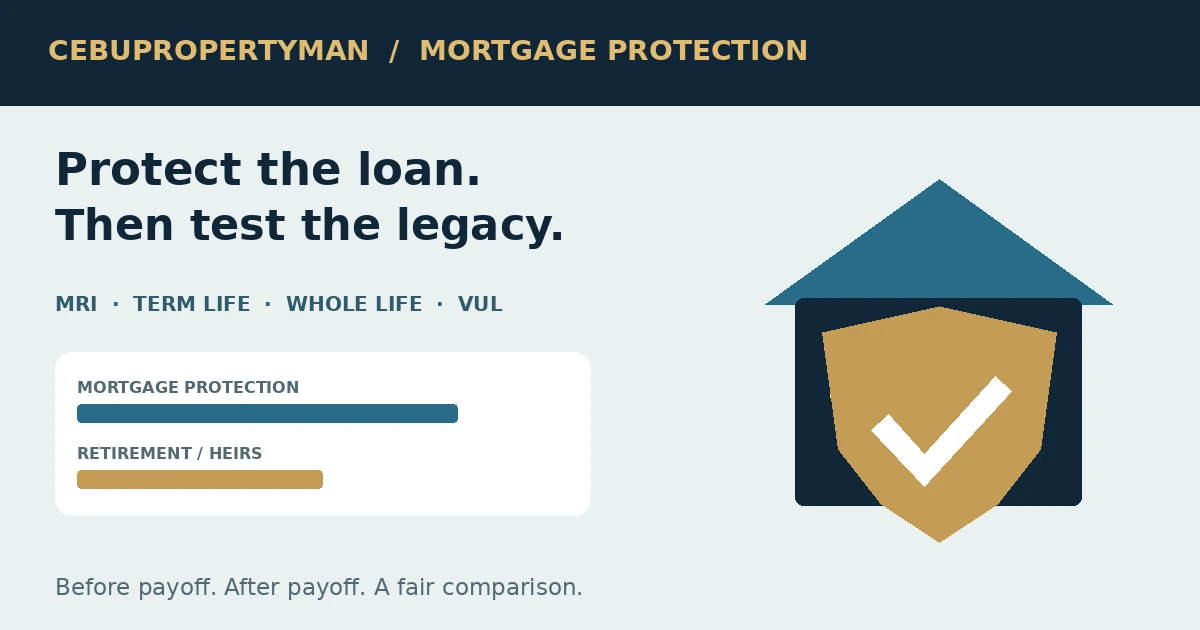
The thesis: one policy, two stages of your financial life
During the mortgage, an accepted life policy is assigned as collateral to protect the lender’s exposure. If the insured dies while the debt remains, a valid claim with adequate cover can settle the outstanding loan. After full repayment, the bank’s assignment is released and the policy is kept in force. A later death claim can then provide cash to the named beneficiaries. A suitable cash-value or VUL policy may also provide access to retirement funds while the owner is alive.
The attraction is concrete: the family could receive the property and an insurance payout after the mortgage has ended. The test is whether that continuing protection and accessible value justify the premiums, charges and lost investment opportunities. An insurance expense still exists inside the policy; only the benefits and values actually retained are credited.
Follow the outcome—not only the mortgage maturity date
| Event | Bank MRI benchmark | Retained life / VUL policy |
|---|---|---|
| Death during the mortgage | Assume a valid, adequate claim settles the covered loan. Any residual beneficiary payment depends on the MRI contract. | The assigned claim first meets the covered mortgage liability. Any contractually payable surplus can benefit the family. |
| Death after full repayment | Mortgage-related cover has ended. Heirs can receive the property and any separate savings or other insurance proceeds. | The family can receive the property and the policy’s total death payout if cover remains in force and beneficiary records are correct. |
| Retirement after full repayment | Separate investments may provide retirement resources. | Permitted cash-value access or VUL withdrawals may fund retirement. These can affect remaining values, cover and funding needs. |
“Loan paid in full” is conditional on accepted cover, a valid admitted claim and the actual policy terms. Exclusions, underinsurance and policy lapse can break that assumption. The calculator makes the full-settlement assumption explicit and flags an entered life claim that is too small.
After payoff, release the bank’s assignment and confirm beneficiaries
This usually means releasing collateral rights and updating or confirming the beneficiary designation—not automatically transferring ownership of the policy to heirs. Sun Life’s official guidance instructs owners to submit a release of collateral assignment after repayment and keep beneficiary records updated. BDO Life publishes assignment and release procedures and accepts individual-policy assignment only subject to bank approval. [2] [5]
The model separates policy issue from mortgage substitution. If you buy a policy in loan year 1 but the bank accepts it only in year 2, the first-year policy premium and first-year MRI are both included. A lender’s approval of one product does not establish acceptance of every traditional or variable policy.
Your year-21 example: property plus insurance proceeds
Consider an invented teaching case: a ₱5 million mortgage for 20 years, a borrower aged 50 at issue, a fixed 7% mortgage assumption, and a traditional policy issued and assigned in year 1. Assume annual policy premiums of ₱100,000 for 20 years, no later top-ups, and a total death payout of ₱5 million if the insured dies at the end of loan year 21. Assume the property is then worth ₱8 million.
The mortgage is already paid. If the bank’s assignment has been released, the beneficiaries are correctly recorded and the policy remains in force, the family’s modeled assets are ₱8 million of property plus ₱5 million of death proceeds: ₱13 million. This is the retained-policy outcome the main calculator evaluates. No surrender cash is taken at mortgage payoff.
Now give MRI a fair benchmark. Use BDO’s published standard reference for mortgage years 1–20, and invest the annual difference between MRI and the hypothetical policy premium at 4%. In this scenario, the separate account reaches about ₱2.49 million by the end of year 21. The MRI strategy would leave the same ₱8 million property plus those savings—about ₱10.49 million.
The retained policy therefore adds roughly ₱2.51 million of modeled inheritance in this particular early post-mortgage death case. Comparing ₱13 million with only the ₱8 million property would overstate its advantage by ignoring the use of premium savings. The 4% return is an editable assumption, not an investment guarantee. The MRI rates are a dated reference from one bank, not a market average. [1]
If death occurs before the mortgage ends
The same hypothetical ₱5 million claim at the end of loan year 10 first meets approximately ₱3.34 million of remaining principal. The residual claim is approximately ₱1.66 million. The property is debt-free under the stated claim assumptions. The calculator separately tracks the MRI benchmark’s accumulated savings and any entered residual MRI payout.
A fixed starting sum assured can exceed the declining mortgage. That excess may be valuable family protection, but the bank’s claim priority, benefit formula and beneficiary rights need the actual contract. Do not assume every MRI has zero residual payment or every individual policy pays its face amount plus its fund.
Traditional insurance and VUL require different evidence
For traditional life insurance, use the contractual cover period, premium-payment period, death payout and paid-up provisions. Separate guarantees from potential dividends. Sun Life’s cited whole-life example illustrates continuing cover and guaranteed cash values; it is not a recommendation or the quotation used in this teaching case. [4]
For VUL, obtain the total death payout under the product’s actual formula. A statement such as “cash plus death benefit” is correct only where the contract pays those components separately. Otherwise, adding fund value to a total that already includes it counts the same value twice. Use the actual contract and claim illustration rather than inferring the payout from a generic marketing description. Sun Life’s VUL guide also warns that withdrawals can reduce death benefits and that a full withdrawal terminates the policy. [6]
VUL retirement access is possible under policy rules, but it competes with the fund needed to maintain protection. Premiums are allocated across insurance, fees and investments; charges may continue after scheduled payments end, and depletion can lead to lapse. Obtain a projection that includes your withdrawals and any later top-ups. [3]
Retirement money and inheritance are separate cash flows
If you withdraw and spend retirement money, it has benefited you but is no longer part of the heirs’ assets. The retirement view shows spending and remaining recoverable policy cash. The inheritance view can include retirement spending before death, then uses the insurer-illustrated total death payout after those withdrawals. It does not add spent retirement money to the inheritance.
Both strategies fund the same annual spending in each comparison. The policy supplies it from permitted withdrawals; MRI’s separate account supplies the equivalent amount. A benchmark account that becomes exhausted is flagged as requiring extra funding. A retirement cash-value snapshot also does not establish lifelong income sustainability. Full surrender would terminate protection; partial access has contract-specific effects. [5]
A favorable death-year scenario is not a lifetime verdict
Year 21 is a useful test, but the insured may die much later. The MRI savings account then has more time to compound. A traditional death payout may remain fixed; a VUL fund may rise, fall or require further funding. Test death immediately after payoff, a decade later and near the end of the contractual coverage period. The calculator does not assign a probability to any of those outcomes.
You can also add a separate term-life quotation to the MRI benchmark. This asks whether assigning and retaining one policy is more effective than buying mortgage protection, separate family protection and investments. The separate quotation must still cover the selected death year; assuming cheap new cover will be available after the mortgage can ignore age and insurability.
Use actual policy values for a decision
- Confirm the bank accepts the policy, sum insured and required benefits. Keep adequate cover during the loan.
- Record the premium schedule, issue date, coverage end date and any post-loan funding.
- Obtain total death-payout illustrations at the selected death years. For VUL, include intended withdrawals and charges.
- Plan the bank’s assignment release and confirm named beneficiaries after payoff.
- Compare the same annual funding budget and retirement spending. Keep guaranteed and projected figures distinct.
This tests a dual-purpose insurance strategy: mortgage protection first, then retirement access or a family legacy. It does not claim that MRI is wasted money, that every VUL is a retirement plan, or that continuing death protection is free.